
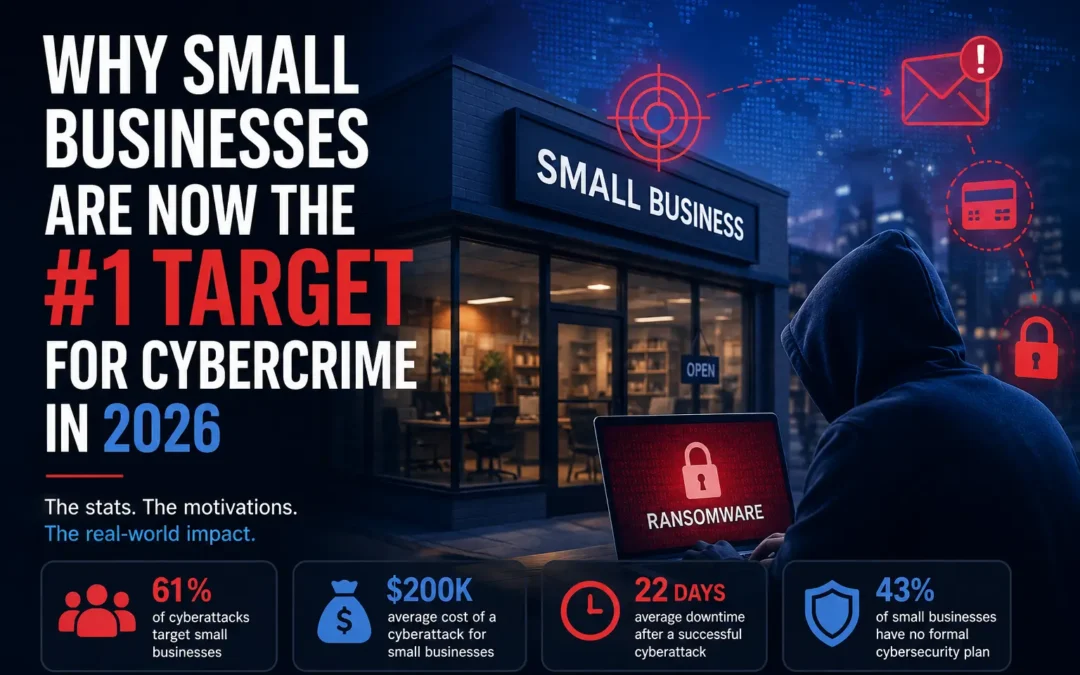
For years, small businesses assumed cybercriminals were “too big” to care about them. That assumption no longer holds.
In 2026, attackers have shifted their focus, and small businesses are now the most frequently targeted segment in cybercrime worldwide. Not because they are the most valuable individually, but because they are the most efficient to exploit at scale.
This isn’t random. It’s strategic.
🎯 The Economics of Cybercrime Changed
Cybercrime today operates like a business. Attackers optimize for:
- Maximum payout
- Minimum effort
- Lowest chance of resistance
- Highest automation potential
Small businesses sit in a “sweet spot” for all four.
A single enterprise breach might require advanced tooling, time, and patience. But a small business?
Often:
- weaker endpoint security
- reused passwords
- old systems
- no dedicated security team
- inconsistent backups
From an attacker’s perspective, it’s simply a better ROI.
🤖 Automation Made Small Businesses Easier Targets
Modern cyberattacks are no longer manual “hacking scenes.” They are automated systems that constantly scan the internet for vulnerabilities.
Attackers now use bots to:
- scan for exposed remote desktop services
- detect outdated plugins and servers
- test leaked credentials at scale
- launch phishing campaigns automatically
This means small businesses are not being “picked.” They are being discovered continuously.
If a vulnerability exists, it’s only a matter of time before something finds it.
🧠 Why Small Businesses Are Easier to Manipulate
Cybercrime isn’t just technical, it’s psychological.
Small businesses tend to:
- trust vendors and emails more easily
- lack formal security training
- prioritize speed over verification
- allow informal IT practices (“just click approve”)
That creates ideal conditions for phishing and social engineering.
A single well-crafted email can bypass thousands of dollars of security infrastructure if human verification is weak.
💰 The Real Motivation: Indirect Value, Not Direct Value
Most people assume attackers want “big money targets.”
In reality, small businesses are valuable in different ways:
1. Ransomware payouts scaled to pain
Even a $5,000–$50,000 ransom can be enough if downtime is critical.
2. Data resale markets
Customer data, emails, and login credentials are sold in bulk.
3. Supply chain access
Small businesses often connect to larger vendors. Compromising one account can provide access to many other accounts.
4. Credential reuse attacks
Stolen logins from a small business often work elsewhere (cloud apps, banking, SaaS tools).
🧩 Real-World Attack Patterns (What Actually Happens)
Here are simplified versions of scenarios we have seen:
1. The “Fake Invoice” Attack
An employee receives an email that looks like a vendor invoice.
One click later:
- malware installs silently
- attacker gains email access
- invoices are redirected to attacker accounts
2. The “Remote Access Entry Point”
A company exposes remote desktop access for convenience.
Attackers scan the internet, find it, and brute-force credentials.
Once inside:
- files are encrypted
- backups are deleted
- ransom demand appears within hours
3. The “Business Email Compromise”
An attacker impersonates a CEO or manager and sends a request:
“Urgent: send payment for this invoice immediately.”
No malware needed. Just trust manipulation.
📉 Why Defenses Fail More Often in Small Businesses
Even when protections exist, they often fail due to:
- inconsistent patching cycles
- no centralized identity management
- shared passwords across systems
- lack of monitoring or logging
- no incident response plan
In other words: tools may exist, but systems are not enforced consistently.
Security gaps aren’t always missing technology, they’re missing structure.
🧨 The Shift: From Opportunistic to Industrialized Attacks
Cybercrime in 2026 is no longer “hacker vs company.”
It’s closer to:
- automated scanning networks
- ransomware-as-a-service platforms
- phishing kits sold like software
- credential marketplaces operating 24/7
Small businesses are no longer being individually targeted, they are being systematically harvested.
🛡️ What Actually Reduces Risk (Practical Layering)
While the threat landscape is growing, most successful breaches still rely on basic gaps.
The strongest defenses usually include:
- multi-factor authentication everywhere
- enforced password managers
- regular patching schedules
- offline backups (not cloud-only)
- email filtering and domain protection
- basic employee security training
The key idea: attackers prefer the easiest path. Removing easy paths dramatically reduces risk.
🧭 Final Thought
Small businesses aren’t targeted because they are small.
They are targeted because they are predictable, connected, and often under-protected relative to the value they can unlock.
Cybercrime has evolved into a scale-driven industry. And in that environment, small businesses represent one of the most efficient entry points available.
ITGuys provides managed IT and cybersecurity services to help businesses stay secure, operational, and prepared for modern threats.
Contact ITGuys Today!
Denver Office – Local IT Support & Consulting
National Services – Managed IT Solutions Across the U.S.
Recent Comments